“Let Politics Begin": a Dispatch from Madrid’s Tenant Union
The Madrid Tenant Union has helped launch a movement that toppled a government and catalyzed a general strike. What’s next for this new practice of politics?
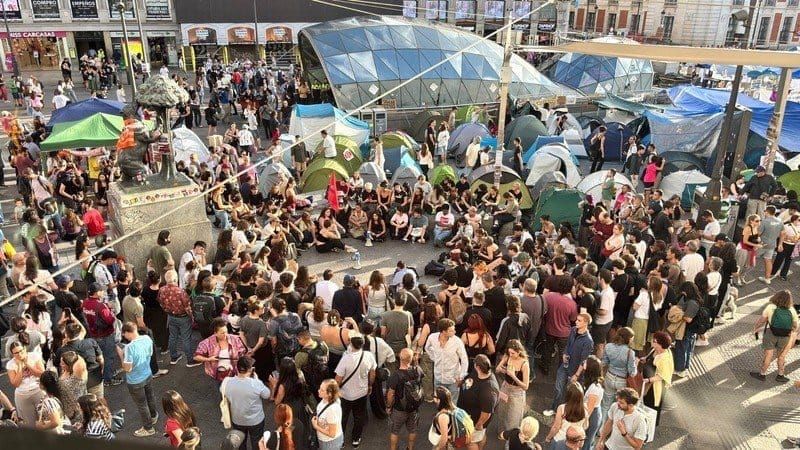
In Madrid, thousands mobilized after an eviction of an elderly tenant captured international attention. Mari Carmen's eviction, and subsequent death, became a catalyst for action. Fifteen years after ‘the movement of squares’ washed onto Spain in the form of 15M, militants have once again built an encampment in Puerta del Sol, the heart of the federal capital.
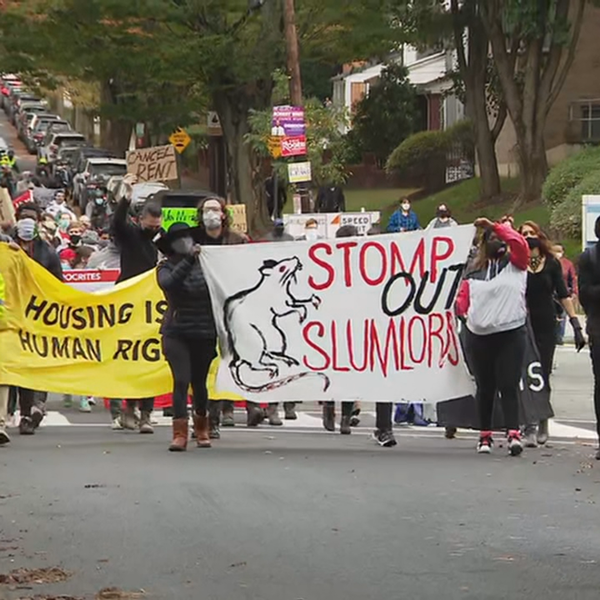
But the mass action unfolding in Spain was sculpted by years of on-the-ground organizing, what both we and the comrades in Madrid both call “spadework,” and was organized by a layer of militant organizers in the Sindicato de Inquilinas de Madrid or the Tenants Union of Madrid. The union was founded in a self-conscious strategy to overcome the impasses of an earlier wave of struggles. As Assiatu Diallo, Elisa Molina, and Pablo Pérez Ruiz—the latter of which we interview here — have argued in a piece we will quote throughout this introduction, the union as a class struggle organization ought: “not to limit ourselves to denouncing injustice, supporting those who suffer it, or intervening episodically, but to build a permanent institution of conflict. An organization capable of uniting material interests, fostering a sense of belonging, training its members, negotiating collectively, imposing costs on the adversary, and accumulating power between one conflict and the next. The return of the word matters because it also signals the return of that ambition.”
In short order, the struggle forced through a consideration of their demands by the national parliament, and already, the impasse has forced the government to dissolve and call early elections. While some on the left cling to a strict division of labor between union and party, where unions are simple transmission belts for the politics of the party, our comrades in Madrid emphasize that “these are different kinds of unions: grassroots unions, built from concrete conflicts, that aim to directly organize those who suffer exploitation and don’t wait for a political party to translate their demands.” As mass organizations, and on the streets, they are practicing politics.
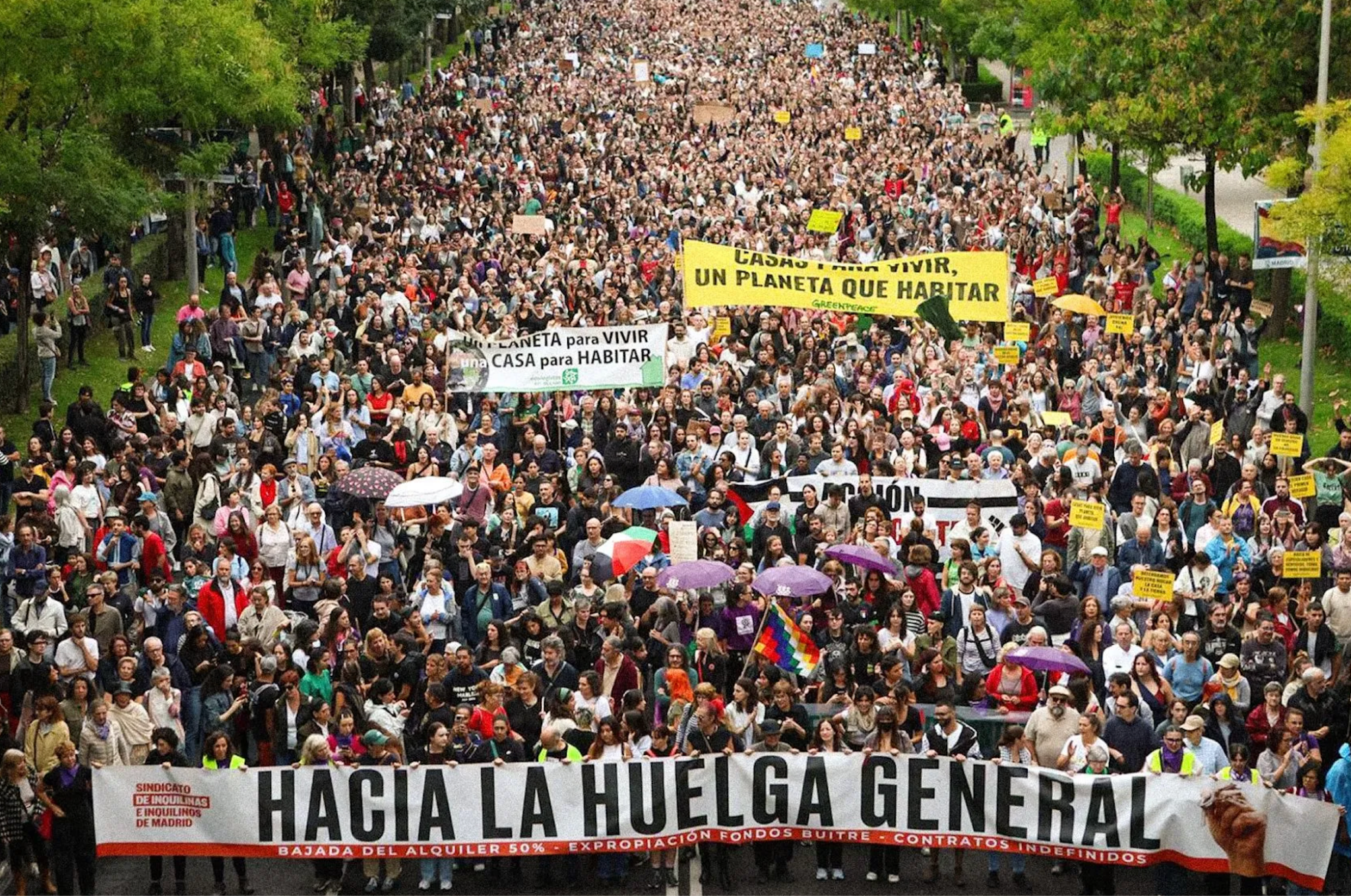
In an effort to escalate the struggle, the assemblies have called for a general strike in November, leveraging connections with the rank-and-file of the labor movement. The hope is that such a call is not only met with a one-off day of action, before the return to normalcy in the aftermath of campaign season, but develops into a sustained effort that tests the relative strength of Spain's working and capitalist classes, one that might produce a deeper political breakthrough that one-day actions have, so far, not produced around the globe.
Seemingly everywhere new struggles are being waged with near simultaneity around austerity and the cost of living, and their fatal coupling with militarization at home and wars abroad. Frequently, in the course of these struggles, crowds are not just populated by singular individuals, or an informal network of activists, but by extra-parliamentary groups of militants, and unions of one kind or another.
It is too soon to tell where these struggles might go, and if they will escape the fate of their predecessors in the cycle of struggle following from the great recession. Regardless of the outcome, it’s already clear that this sequence of class struggle is significant for finding political coordinates appropriate to our deepening crises of hegemony. As our comrades say, “the time for politicians is over. Let politics begin.”
— Ben M
Ben M and Sebastian FG, members of Communist Caucus, discussed the situation with Pablo Pérez Ruiz, a leading organizer with the Madrid Tenant Union. The transcript below has been lightly edited for purposes of brevity and clarity.
Ben M and Sebastian FG: You’ve said elsewhere that the day-to-day organizational spadework of the tenant union prepared the ground for this more dramatic political intervention in the streets. What made this nationwide mobilization possible — what were the different organizational practices that built up capacity for this moment?
Pablo Pérez Ruiz: What looks like a sudden eruption from the outside obviously rests on years of organizing. An eviction can provoke enormous anger, but that anger alone does not explain why people organize and take risks together or keep coming back. So for us in the Madrid Tenants Union, the foundations are very concrete: talking to neighbors, bringing people into the assemblies, identifying tenants who share the same landlord, turning individual problems into collective demands, and accompanying one another through conflicts that can last months or years. Through that work, people have learned how to run a meeting, how to negotiate, how to speak publicly, and how to support someone else through fear, and those are the capacities that become essential when a much larger mobilization happens. There are obviously different layers to this. There is organization within buildings, neighborhood structures that connect otherwise isolated tenants, and coordination between housing organizations, across cities in the Confederation of Tenant Unions that we set up in 2025. So nationwide mobilization becomes possible when there are organizations capable of responding locally to a shared call. And obviously, victories matter too. They give people the evidence that organizing can change something, and the relationships built through difficult struggles create that trust. You participate because you know someone will stand beside you.
Mari Carmen's eviction brought the public into contact with our organizing, and our task was to give public outrage a collective direction. It became clear that we needed to adopt a broader movement role because we have always understood housing as a political conflict that goes beyond our union’s members. But there are obviously moments when the scale of participation changes what an organization needs to do. Around Mari Carmen's eviction and the subsequent mobilization in Puerta del Sol, people who had never attended a union assembly began to identify with the struggle; they recognized their own insecurity in what had happened to Mari Carmen. This created an opportunity and a responsibility for the union to articulate demands for a much broader social majority..
So the union is an organized force within a movement that obviously exceeds it. Our union brings experience, relationships, demands, and strategic proposals, but we do not own the movement or the encampment. Other organizations and people bring their own experience and initiative, too, and they have also participated in encampment. Our challenge, then, is to provide direction while creating room for others to act.
At the same time, we need to maintain the organization that made our contribution possible, which is all the neighborhood assemblies, the base membership, and the ongoing landlord conflicts. Those, for us, are essential to sustaining the movement beyond its most visible moment.
BM, SFG: How is this social movement organizing different from day-to-day work and how is it similar?
The biggest differences for us at this moment are obviously speed and scale. In everyday organizing you can spend weeks understanding a building, developing relationships, and finding out who is ready to take responsibility. But in a moment of mass mobilization, thousands of people arrive before you have structures ready to welcome them. So decisions become urgent, public attention increases, and the demands on experienced organizers can become overwhelming. But the underlying question remains very similar: Who are we organizing? What can we win together? What are people prepared to do? And who will take responsibility for the next step?
In these moments, the danger is that the rhythm of mobilization consumes all our capacity. We can spend every day preparing the next demonstration while neglecting the relationships and structures that would make us stronger in the long-term. So we understand that we need both. Obviously, mobilization can bring people into struggle and change their sense of what is possible, but organizing gives people a way to stay, to develop confidence, and to exercise power. Our measure of success has to include how many people can organize with others once the immediate excitement subsides. In terms of how we developed our demands and why these demands.
BM, SFG: You’ve demanded steep rent reductions, price controls, caps on rent increases; a permanent ban on evictions; suppression of short-term tourist rentals; and even the seizure and socialization of large privately owned housing stock. How did you come up with your demands, and why are you making them?
Our demands come from the problems that tenants repeatedly bring to the union. Different buildings and landlords have produced remarkably similar experiences, like unaffordable rents, insecurity when contracts expire, displacement, and homes being treated as investment assets. That's why rent reductions and indefinite leases belong together for us.
Unaffordable rent means little if you can be forced out when your lease ends. And security means little if staying requires handing over most of your income. So indefinite contracts are particularly important as e they address the insecurity at the center of the landlord-tenant relationship in Spain. People need to be able to build a life in their home without periodically having to persuade a landlord to let them stay. And in this sense, Mari Carmen's experience made the consequences of insecurity painfully visible. So recovering housing from investment funds and ending its conversion into tourist rentals addresses also the wider questions of what homes are for, and that's why that's also one of our main demands. Together, these demands offer immediate improvements to the working class tenants, while also challenging the power to make money from other people's need for shelter. Our guiding principle is simple: homes should be for living.
BM, SFG: Though veteran militants and union members anchored the movement, providing it with some consistency and strategic instinct, you’ve welcomed–even encouraged–mass participation, and have sought to practice a form of leadership distinct from strict organizational control. As you’ve reflected elsewhere, this fantasy of control rarely works anyway, “because there are always newcomers, informal networks, neighborhood groups, activists from different organizations, people who don’t want to join any, spaces for self-organization that emerge during the conflict itself, and initiatives that could never have been designed by a coordinating body weeks beforehand.” This is nothing to decry or to scramble to correct, however, because “it is one of the sources of power for any mass movement.”
Nevertheless, there is a massive wave of mobilization taking place far beyond Spain, reaching far wider numbers of people than are on the membership rolls of any particular union, and one test of the movement will be the long-term energy it provides for this level of organization. How are you organizing the new people flooding in, and how do you orient them to the movement?
The first challenge for us is to transform the first contact from someone new in the movement into a relationship.
Someone may arrive because they are angry, because they need help, or because they want to contribute. We need to listen and offer a clear next step. And at the encampments at Puerta del Sol, for example, the union's tent and welcome spaces help people find information and ways to participate. But obviously, the longer-term route is into neighborhood chapters and ongoing struggles where people can get to know others and take responsibility over time.
Our orientation is that the union is something we build together. You may come because of your own housing problem, but you become part of an organization in which we defend one another, and we make that clear from the get-go. This requires manageable tasks and support, like helping welcome people, speaking with neighbors, preparing assemblies, accompanying conflicts, and also giving people a lot of training and support, because giving someone responsibility also means making sure that they have someone to learn from. We also have to accommodate very different lives because someone with children, with irregular working hours or limited confidence in speaking in public needs a meaningful place in the organization, so participation cannot depend on being available every evening. We bring the union to them.
BM, SFG: In recent years, there is a growing current of militancy and self-activity taking place amongst teachers in the country. On October 14, a teachers' strike in Madrid is set to begin. In the States, we’ve seen that teachers' strikes can often be rendezvous points for various layers of society, parts of the working class, to take joint action together, given their relationship to diverse student bodies and their central role in social reproduction. How does the tenant union think about the teachers' strike, and how does it relate to it?
Our starting point is that the teachers' struggles and tenant struggles concern the same people and the conditions of the same neighborhoods. Most teachers pay rent, and their students also experience overcrowding, displacement, and eviction — so housing insecurity enters the classroom every day. There is a direct relationship between wages and housing costs because a pay increase can be absorbed by a rent increase. So, defending workers' living standards means organizing over both. And the relationship we want to build is reciprocal.
Teachers of course have their own demands and organization, and supporting their struggles has to mean taking those seriously. From there, we can build shared discussions around practical solidarity and between workplaces and neighborhoods. Politically, this opens up a broader discussion, which is: what does it take to live in this city? Housing, education, care, wages, and public services are connected parts of that struggle, and those connections become powerful when people organize around them together.
Here’s an example: for the last year and a half we've been running a pilot program in most middle schools and high schools where teachers who are in the teachers union are connected to the tenant union organizers. They can map out the housing problems that their students are facing. This allows the tenant union to intervene, or at the very least, the families of students now know that the tenant union exists. This project enables us to develop solidarity with the teachers union from the working class base, rather than through discussions by leaders who can only establish high-level, formal agreements.
BM, SFG: In the United States, many of our political and strategic conversations lately turn to the question of leverage. Where do you think the power of the movement currently derives from? Where is its leverage and disruptive potential? You've also called for a general strike as a way to escalate the movement further. How would the outpouring into the streets of workers transform the struggle?
Part of our power comes from the breadth of our identification with the problem of rentierism. In the last two years housing is and has consistently been the main social problem cited in polls of Spanish society. Housing insecurity reaches far beyond all those already organized, and the movement has helped turn those experiences often lived privately, with shame or resignation, into a public conflict with identifiable interests and demands.
But public sympathy only gives us so much leverage. We also need the capacity to impose costs on our real estate opponents, and make their decisions harder to carry out. So collectively contesting landlord demands, defending people against displacement, and developing the organization necessary for sustained rent strikes are all key. But, a general strike, which has been currently called for November 11th with the support of the main labor unions, Comisiones Obreras and UGT, would extend that power from the neighborhood into workplaces.
For us, workers withholding their labor can create economic pressure that a demonstration alone cannot, and it would make housing a question employers and government have to confront as central to working class life. But making this kind of political crisis largely depends on what happens before the strike. What conversations are happening at the workplaces, what assemblies are being done at the neighborhoods, what organizing is happening among work colleagues? What are the connections that we are building, or which can be built, between workers in labor unions and tenants in housing organizations? Those kinds of organizing conversations can bring many more people into concerted, collective action.
Also, we should also distinguish the labor part of the general strike from the social aspect of the general strike. For us, the role of the general strike is not only to stop production, but to stop consumption too, and reproduction of the operation of the city in general. We want to make the city stop on November 11th, not only to highlight that we're being kicked out of our own neighborhoods and cities, but also that we are the ones who make the city run. We will bring the city to a halt if we can't live in it anymore.
BM, SFG: The movement in Madrid has resurrected two organizational practices that were prominent in the movement of the squares, including Occupy in our country: the assembly and the camp. Let’s discuss the former, which was also common during the student encampments for Palestine and is a recurring feature of street-based social movements. What is the place of democracy within the movement? How are assemblies run, and what sorts of decisions are they making?.
Democracy is central because people have to shape the struggles whose consequences they will live with. This is especially important when decisions involve someone's home, income, or exposure to retaliation.
At the same time, there are obviously different levels of decision-making. Tenants in a building need to decide their demands and how to approach their landlord. Neighborhood chapters connect those struggles and organize mutual support, and a broader movement assembly provides space for common proposals and collective action. These spaces have different responsibilities, and we need to be very clear about how they relate.
How this all happens matters. For an assembly to be democratic, people need to have enough information to make a decision, a clear proposal and time to discuss it, and an understanding of who will carry it out. Facilitation matters a lot for us, and so does making space for people who are less confident or less accustomed to political meetings.
We should be honest about the limits of open assemblies as well, because people with more time can participate more often, and confident speakers can dominate. Urgency can also concentrate decisions among a small group, too. So our task is to address those inequalities through accessible participation, sharing responsibilities, and accountable leadership. Democracy means expanding the number of people capable of making and implementing decisions, but also being very clear that not every decision has to constantly be made by the largest group.
Once you have decided on a set of principles with large groups, smaller groups can begin to make decisions. Those smaller decisions can, in turn, be made accountable to the larger group if the larger group decides or thinks that that decision went against its established principles.
Sometimes we have this fetishism of democracy, where we think every decision has to be made by the largest group of people possible. This can be counterproductive, and can actually fail to address the efficiency or the efficacy of the organization. It can also work against the real concerns of its base, at the expense of pleasing those who are fixated on ideal types of democracy, which is sometimes actually about retaining control of the organization.
BM, SFG: It’s striking that, although you obviously recognize the important role of formal leadership within the union, you do not prize structure for its own sake, or mistake the formal trappings of organization for its actuality. You’ve written instead that the real substance of organization resides in what it enables and facilitates amongst the rank-and-file: “an organization can have an impressive organizational chart and not actually organize anyone; the question remains what capacity it develops among its own members.”
Let’s return to the encampment. In a recent piece of writing, you’ve clarified that the protest camp is not a ‘commune’ in waiting, but a school for developing union organizers. The union has also determined to continue supporting the camp, but has also determined to deemphasize it, and return also to work within neighborhood committees and beyond. Meanwhile, we’ve recently seen the encampment work as a platform for other tactical interventions, as with the viral video of a massive eviction defense pushing back a line of riot cops. These tactics were exciting: it seems to be a practical instance of an eviction freeze, as practiced by the movement. How else is the encampment being used a center for other tactical initiatives, and do you imagine them as hopefully durable? And why, despite these initiatives, should the camp’s importance be relativized?
The encampment has concentrated people, relationships, and practical resources in one place that reduces the distance between hearing about problems and being able to respond to problems collectively. So someone could arrive through a demonstration, meet experienced organizers, and find ways to participate in another action. But we also left the encampment as a union in the first week, even though the encampment had decided to stay and to continue, because we also realized the limitations of staying at the encampment in terms of all the resources it was using that we could be putting towards, for example, organizing the general strike or organizing our buildings and neighborhoods.
The eviction defense that you mentioned shows what that concentration can make possible. It demonstrates the capacity to prevent a particular eviction from being carried out, and that challenge is to extend that protection beyond the cases where we can assemble enough people at the right time. So the encampment has also created opportunities for political discussion, welcoming newcomers, and building relationships between organizations.
For many people, the encampment has become an intensive school of collective action, and it has had an important effect inside the union as well, because working alongside people and groups across our neighborhoods helps rebuild familiarity and trust among union activists and organizers. Those relationships matter when we later ask one another to make difficult decisions, or to keep momentum sustained amid a fight. But maintaining the encampment requires a lot of work, and its continuing existence cannot become our only measure of success. So the question is, what are we bringing to the neighborhoods? Are we making new organizers? Are we building stronger relationships and coordination and the capacity to sustain future struggles?
In the end, what we want to make durable is the ability to act together. For us, the camp's greatest ideal contribution would be to make the capacity for collective action even more widely distributed.
BM, SFG: Let’s turn a bit to the horizon of this fight. In Berlin, there are calls for expropriation of privately owned housing, and in NYC, tenants are organizing under the demands of municipal ownership but democratic tenant control of distressed bankrupt buildings. What's the horizon in Spain, in the movement? Is this a moment to socialize housing? What, in your view, does the role of tenant unionism, tenant control, and democracy within our homes and neighborhoods play in that socialization?
We should definitely use this moment to make the socialization of housing a concrete political horizon, and one of our demands is the expropriation of housing owned by vulture funds. Currently in Spain people are questioning why the ownership of a home gives its owner extensive power over another person's life, and that has created an opening to discuss ownership, allocation, and control. Our immediate demands can move us in that direction, reducing rent, securing people's right to remain, and recovering homes held by investment funds. These measures can improve lives while expanding housing organized around social needs.
But the socialization question raises important issues that go beyond who formally owns a building. Public ownership also needs to have lasting protections against privatization because if all the housing that was built with public money or on public land in Spain still were public, 40% of our housing stock would be public. We need to be very careful with those protections and also have adequate resources and meaningful democratic accountability, because the little public housing that we have is not well-maintained, and tenants have very little control over it. Residents should have a real role in decisions about maintenance, investment, and the conditions of their home. This question of democracy also needs to be extended to people who do not yet have secure housing. We need fair access for future residents and protection against exclusion, so tenant control and the universal right to housing develop together.
We think tenant unions can make this possible by building the collective capacities that people need to exercise control, and we view unions as remaining necessary under public ownership. Tenants will still need an independent organization to defend their interests and hold institutions accountable, even if conditions improve through socialization.