Tenant Organizing Through Elections
How Stomp Out Slumlords Used An Electoral Campaign to Build Tenant Power
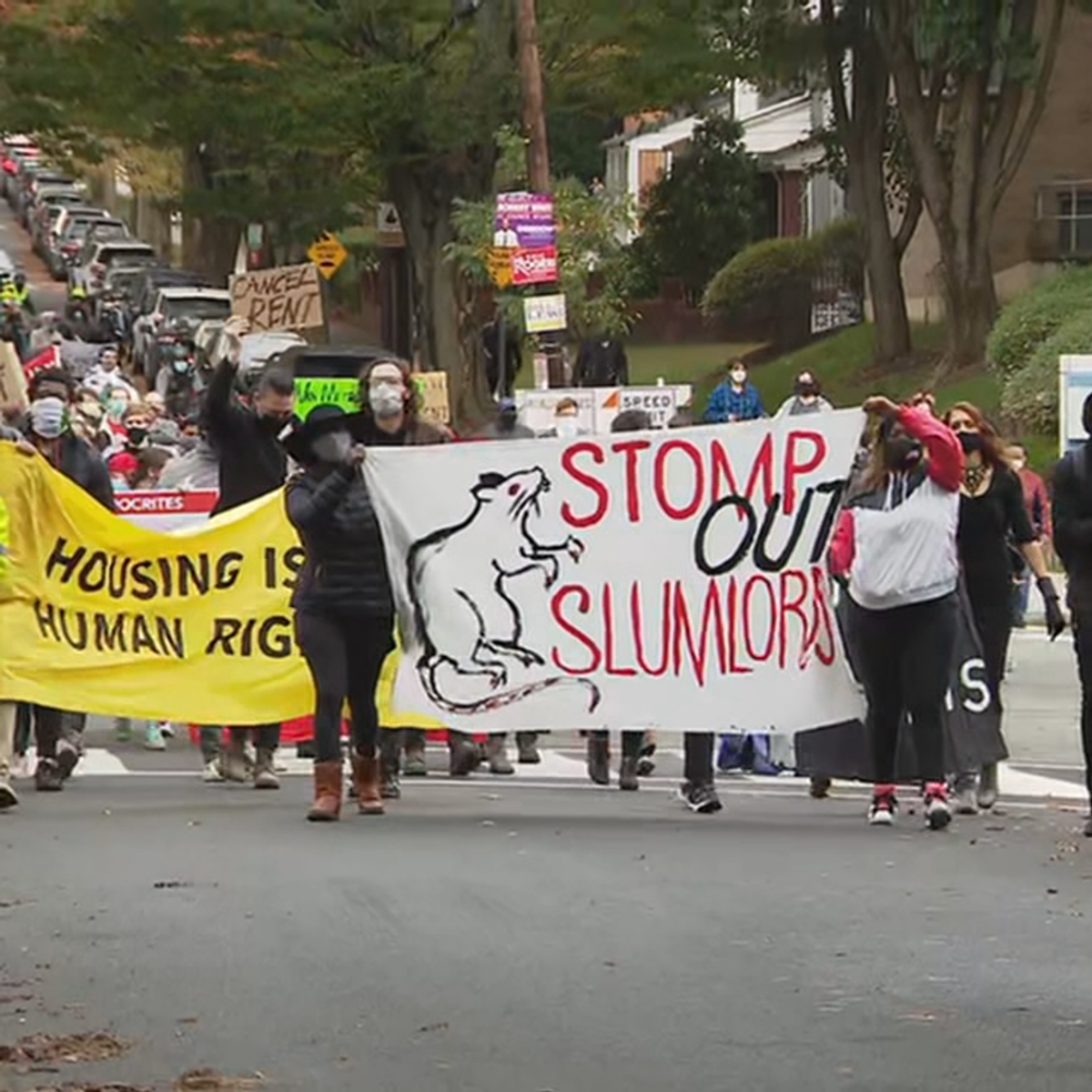
Stomp Out Slumlords (SOS) is Metro DC DSA’s tenant organizing program, formally structured as a working group of the chapter rather than existing as a separate entity. Originally founded in 2017 as an anti-eviction canvassing project, SOS quickly evolved into a dynamic crew of tenant unionists building tenant unions/tenant associations (terms used somewhat interchangeably in DC) across the DMV. Paralleling developments in the autonomous tenant union movement across the country, SOS reached a peak of influence with a wave of COVID-19 era rent strikes, followed by a relative stagnation as the political economy of housing shifted.
A renewed offensive against the District’s working class, where local developer capital and their lackey Mayor Muriel Bowser worked hand in glove with Trump’s fascist attacks on Home Rule, has set off a new wave of social movement activity in DC. With Metro DC DSA endorsing sitting Socialist Ward 4 Councilwoman Janeese Lewis-George’s campaign for Mayor, along with former MDC DSA Chapter Chair and SOS Coordinator Aparna Raj’s campaign for the Ward 1 council seat, SOS decided to make an experimental foray into collaborating more closely with Metro DC DSA’s electoral program. The following interview reflecting on this effort was conducted with three SOS Coordinators.
Sebastian - Tell us a little bit about yourself and how you got started doing tenant organizing.
Martin - I'm a lifelong Washingtonian, and the housing and displacement crises shaped my politics growing up, so housing always seemed like a place to do political work. I saw Stomp Out Slumlords (SOS) organizing and got involved. I had the pleasure of organizing alongside tenants at what's now Buena Vista Cooperative. We had a rent strike, and when the building went on sale, tenants bought it through the Tenant Opportunity to Purchase Act (TOPA). They now control it as cooperatively owned, permanently affordable housing. It was nice to start with something that went so well, although it may have given me ideas about the likelihood of victory that haven't always borne out.
Connor - I was coming out of college and ended up at Tivoli Gardens. And one day on a Sunday morning, I am wet as a dog from the shower I just took and still in my underwear and I get a knock from two of my neighbors. And they knocked on my door and said, hey, we're having a general membership meeting for the Tivoli Gardens Tenant Association that we're trying to kick back into action. Do you want to come? And I said totally. At the general membership meeting, I was starstruck by how organized the Tivoli tenants already were and just how many issues seemed to plague the building. I'd seen a couple of roaches, you know, my AC unit would start spitting out black mold. Packages would be stolen constantly. And people who had been there much longer had a lot more to complain about. And so I just kind of on a whim decided to sign up for the organizers meeting that the Tivoli Gardens Tenants Association was hosting. And through SOS, primarily Stephanie B., we were encouraged to take increasingly bold action against our management, which culminated in a 2024 rendezvous to our property manager at the time, Ross Management. They were just completely dumbfounded that a bunch of tenants showed up to air their grievances. A year or so ago, I was then again approached by Stephanie, who asked me to join the SOS coordinating committee, which I said yes to. And then I started paying DSA dues, which I still do to this day.
Rohin - So I grew up in the San Francisco Bay Area, a very, very wealthy, expensive, but very unequal place also, where like housing costs, displacement, all of that was a very constant issue. I grew up seeing a lot of friends getting displaced, being priced out of the community we grew up in, people commuting a long ways. And I got involved all the way back in high school in defending rent stabilization through a tenants group in the neighboring town to where I grew up in, in Mountain View, California, at the time also with Silicon Valley DSA. And then in 2021, I moved to DC for college and pretty quickly also got involved both as a volunteer helping some of the NGOs that were supporting tenants who were organizing their neighbors in TOPA fights and also with SOS's anti-eviction canvass program. And then, after joining the SOS coordinating committee, I helped start Metro DC DSA’s community defense work that was heavily structured around supporting vulnerable tenants in the buildings that we had organized in. And then went on to be heavily involved in the electoral process in this cycle as staff for one of our endorsed candidates, Janeese Lewis-George for mayor.
Sebastian - Okay, so it sounds like y'all have been involved more on the tenant organizing side rather than the electoral side. And so I guess the obvious question is: why did y'all feel that this was a good campaign to support? How did y'all make that decision?
Martin - Yeah, so this cycle, Metro DC DSA had two endorsed candidates in DC, Aparna Raj and Janeese Lewis-George. Janeese Lewis-George is a sitting councilwoman, now presumptive future mayor of the District of Columbia, but she was Metro DC DSA's first member elected to the council.
She is not what we in DSA would refer to as a cadre candidate, but she has been a strong ally in tenants' rights struggles, including standing with tenants in her ward that went on rent strike.
So we've always seen her as someone who's very much a strong ally for SOS. And then Aparna Raj actually came into DSA through SOS.
Why did SOS make the decision to get involved the way that it did? First, Aparna’s case for her election was this idea of trying to polarize the tenant vote behind a candidate who was a tenant organizer and really putting forward tenant issues on her platform.
We thought that was all well and good, but the electoral effort needed to be backed by real relationships with the existing tenant movement. We needed to use the campaign to strengthen tenant organization and build a bridge between the tenant and socialist movements.
Additionally, and this was a sort of more opportunistic way to think about things, we were looking for a collective project. Over the last few years, we've found that SOS is often at its best where we have a concrete collective project to work together on across buildings, something that gives us a real ability to sort of move past the building to building level struggle, which of course is super important, and tenants associations are always going to be strongest when they are able to fight and win at the building level. But also, in order to have sort of a broader tenant movement, there need to be real reasons for tenants associations to collaborate on a project outside of their building.
Sebastian - You were talking about having a collective project to tie together these tenant associations. What exactly did that look like? Were the tenant leaders in each building getting together to strategize this?
Connor - Yeah, I can speak primarily from a Tivoli perspective. Though I would argue a lot of our tenants in the association are quite radical, not all of them are in DSA. Some of them like to abstain from organizations entirely.
I approached the tenant association to say SOS has this collective project where we're trying to get socialists elected to DC, and I mentioned that Aparna was running. There was a lot of excitement around her candidacy, but we didn't necessarily know where to start. What would it look like? How would a tenant organization even help a candidate reach that office?
And we decided to approach tenants and say, this candidate has directly asked us to endorse them. Do you consent to that endorsement? And we knocked on every door in the building. We did several rounds of email campaigns and messaging and WhatsApp chats. And one of the long-term Tivoli Gardens tenant association members would sit out and let people know about Aparna through tabling. And after a two-week-long campaign of getting everyone gathered in the building, we – including people who weren’t in DSA or even formerly part of the TA – had formally voted to endorse Aparna.
As for cross-communication with other buildings, we worked directly with the Woodner Tenants’ Union to help their endorsement of Aparna, including helping out their internal canvassing program. So not a lot of internal strategizing, but more figuring stuff out on the fly: what's the best way to frame something to another tenant in the building, how can we leverage our connections with members who are not involved, or neighbors who were kind of on the fence but needed that little extra push. It was a really rewarding experience overall, and I think it actually had further strengthened our tenant association because now we got our name out there, and we had formally endorsed a candidate, and we'd all have now the practice of knocking on doors, which is super integral for any other like future endeavors that we want to do.
Now that kind of mystique around it has totally eroded, and I think we're ready to push for more aggressive action against management when the time is necessary.
Sebastian - Did y'all have any conversations about what the thinking was behind a candidate asking for a tenant association’s endorsement? Are there voters that tenant associations can reach that campaigns can't?
Connor - This is a great question. I think one of the benefits of having the tenant association endorse the candidate directly is that more manpower can be spent elsewhere, and we were able to lock down Tivoli. We had a group of pretty dedicated organizers, both to the tenant association and also the campaign, who would routinely canvass or flyer for Aparna.
We had a huge canvass launch from Tivoli Gardens for both Aparna and Janeese, I think sometime in early May. It was a group of tenants from Tivoli who just canvassed the building like they regularly did. And everyone else went to other buildings that we were trying to get a foothold in or helping the Woodner Tenants’ Union, who represent the biggest apartment building in all of DC with more than a thousand units.
Rohin - I think there are some unique strengths of having folks talk to their own neighbors about the election within a building, and that's something we, from the Janeese campaign staff-driven side, really pushed both in organized buildings as well as non-organized buildings. If there were identified supporters who had volunteered already or had donated or come to an event or something, we made the ask specifically, not just to canvass, but to canvass in your own building.
I think for one thing, it was just the logistics of getting inside the building is easier. But also I think it's just such a more powerful interaction someone has with their own neighbors. It’s that experience of politics not being talking to other people, somewhere else in the city, or talking to the list the campaign gives you, but talking to the people you see every day coming in and out of your own building. I think that really anchors people in a different way of doing politics, which I think is something that is really central to who we as DSA are. Politics for us is what we embody in how we interact with our neighbors on a daily basis.
And I think having a first experience of electoral canvassing being talking to your own neighbors is something that was really powerful for a lot of people, and something that I think has generated a lot of organizing potential for us going forward.
There are a lot of people, who maybe had volunteered on campaigns before or maybe hadn't, but then this cycle had for the first time an experience where what they were asked to do was to actually talk to the people that they may know the best. To use the campaign in a way that actually builds their own relationships with their own neighbors, and to talk about the city that they want to live in with their own neighbors, whose biggest issues may be, in many cases among renters, that the rent is too high and landlords don't maintain properties because they're squeezing every possible set they can out of working people.
Martin - Yeah, and to just tie a little bit of what Connor and what Rohin were saying together, in SOS, we had a sort of failed attempt to build up an autonomous tenant union here in the district.
It petered out in part because we were doing it just to do it. We convened meetings but got bogged down in bylaws and the constitutional process. Ultimately, the project died.
So instead of focusing on building something region-wide that stretched from Montgomery County to various parts of DC to Northern Virginia, we have recently pivoted to trying to develop the sort of fabric of a social movement on a neighborhood level. And looking particularly at how do we, in our areas of highest density, actually take that qualitative step from the individual building level to a neighborhood level social movement, that can then serve as a strong base to go into the regional, rather than just trying to abstractly conjure the regional through a bylaws process.
Connor was mentioning that from Tivoli Gardens, we were launching canvases that then went into other buildings. There is a building we canvassed, the Cromwell, where the residents were asking us, “How do I start a tenant association in my building?”
And in doing this, not only were we trying to give tenants an excuse to go knock on doors, but we were also building this really concrete relationship of solidarity between tenants at the Cromwell looking to organize and tenants at Tivoli Gardens who were better organized, and could support them in doing that work.
We were able to sort of start to build those kind of concrete connections across buildings. Literally just people knowing each other, people seeing each other's face. We even had a very nice social, hosted by our friends at Tivoli Gardens, our tenant unity block party. And you know, Aparna came by, but we also just had a lot of folks from Tivoli Gardens and from other buildings come, hang out, have some nice grilled meats, and actually get to know each other.
Sebastian - That's awesome. Now, I've done electoral canvassing before. It's very sort of, “Hey, what's up? Here's the pitch,” it's kind of salesy. It doesn't build like a long-term relationship. And so maybe this is a little in the weeds, but how does the script change? How does the conversation change when you're trying to combine these two things of tenant organizing and electoral canvassing?
Rohin - Yeah, I think there's a couple of kind of big things on this, and I want to start with a particular story of this one DSA member who's on a canvass for Janeese in Ward 3, in a more diverse, more renter-heavy part of Ward 3, but Ward 3 is kind of the more homeowner-heavy, wealthy, white section of DC.
And with this comrade, we were going over where we would go for this canvass, and one of the options was for this comrade to canvass in her own building, which she was very unsure about doing. She was saying “ I don't really know my neighbors, some of my neighbors are weird. Is there somewhere more useful I could go, somewhere where people actually vote,” things like that, right? And I particularly pushed her to stick with her own building and not knock on just the doors on the list. I think just that ask in and of itself, starts a mindset shift. If you're not just going based off of what's on the VAN, you have to start actually using your knowledge of people, and it's not just names on a list. And then we did a couple of doors together before I left her to finish the building on her own and have the confidence to do that. The first door we actually knocked on was not the person on the list. It was someone else who had moved in, who was very excited to be voting for Janeese because of Janeese’s stance on rent stabilization. And this comrade was talking, did not know that this person lived on her own floor. And at that point, we were debriefing that conversation. And I was like, “You should go back and make plans to meet up with this person again. They're on your floor.”
And that was kind of the attitude carried through the rest of the canvass of her own building. Which I think that really was one example of many of how we push people to think about how they were speaking with their neighbors, not just as asking for a vote, but also pushing people to build a relationship there. And that was just such an integral part of the renter-focused campaigning that happened, both in organized buildings in Ward 1, where a lot of the tenant leaders were carrying it for both Aparna and Janeese, as well as outside of Ward 1 for Janeese.
There were also buildings where there's ongoing organizing struggles, where we used the campaign being there as a sort of catalyst for speaking to more people in the building and making sure to bring people together.
Sebastian - That is just so awesome and so funny of the DSA member saying she didn’t want to talk to her neighbor, and it's just great to see electoral campaigns helping to start to break down some of those hesitations. Looking into the future, assuming that the general elections go well, how do you all see the relationship between these tenant associations and the elected officials? And how do you see the organizing terrain changing based on this work?
Martin - Yeah, that's a great question, and it's something that Stomp Out Slumlords has been debating. Just at the beginning of this month of July, we had a general membership meeting where the whole topic of discussion was, “What now?” You know, this is a city where Kamala Harris, I believe, got 94% of the vote; the Democratic primary is basically the general election.
I think for us, there are two parts to it.
First we would like to see the District participate in real housing code enforcement. Currently, the Department of Buildings, which is in charge of building inspections in DC, is just structurally incapable of doing its job. It is nearly impossible for tenants organized in a tenant association to easily request an inspection of the building as a whole. Oftentimes, the inspectors no call, no show, which leads to working people taking time off work, taking time out of their days just to be stood up. And even when the inspectors come in and give fines, the District doesn't actually collect the fines.
Housing code enforcement won't solve the crisis of tenancy, but it would give tenant associations a real way to pressure landlords short of a rent strike. Our TAs need other points of leverage to build toward that kind of large collective demonstration of power.
The second issue we've been facing recently is something Stomp Out Slumlords has been pushing throughout the election. We were even able to bring it up as an election issue at our Tenant Power rally with Janeese Lewis-George and Aparna Raj hosted inside the atrium of the Woodner.
And at that rally, in addition to having our socialist candidates speak, we also had tenants speak.
One of those tenants that spoke was GG from the Channel Square apartments – people who follow SOS on social media may have seen five months ago; she was arbitrarily arrested in her own building during a tenant association meeting because management had issued this bullshit barring notice against her, saying that she had no right to be in common areas.
Thankfully, we've been able to, in GG’s particular case, fight back against management, and get that barring notice repealed. If anything, that has only reinvigorated organizing in that complex.
But this is a real tool that we know that landlords are using across the city, and that sort of gets into issues of socialist municipal executives and police power. But we would like to see a socialist mayor of DC tell the police to not enforce these barring notices. DC has, from the 1970s, a codified right of tenants to organize in their buildings and protections from landlord retaliation. These rights are not often enforced in practice, but we think that there's a pretty clear legal basis to say that these barring notices, especially when used in the sort of retaliatory manner against tenant organizing, are not only wild violations of the First Amendment, but of DC's own laws.
Rohin - So, I mentioned a little bit previously, but I think one of the big things for both of these issues we talked about, of enforcing the right to organize and a conditions enforcement crackdown. Both of those demands that we have of the leaders that we have worked very hard to get elected are things that add to the organizing toolbox, and add to the legal toolbox we have as organizers.
And then similarly, through the campaign, there are a lot of people who have been primed to think more about talking with their own neighbors. And we've broken some of that ice a little bit. When our elected leaders take office, we need to majorly scale up our tenant organizing capacity.
That is going to require retraining volunteer electoral leads into doing longer-term tenant organizing work, and assisting the many people who we’ve identified in our electoral canvassing that have spoken up and said, “Hey, I know people in my building and we're all having the same issue.”
We need to very effectively support the very large number of people who have actually come forward at the doors saying that there are issues that they're facing that they're willing to organize around. And I think that's going to be our next big test.
Rohin- I think one thing I just want to raise from our experience here, is that it was very productive, both for the sake of our long-term kind of non-electoral organizing of the working class, and for the sake of our effectiveness as an electoral project, to think really deeply throughout this election cycle of all of the ways that those two things very cyclically feed into each other and strengthen each other, and how we use the electoral work as a tool for the ongoing organizing and how people who are organized through our non-electoral, structure-based organizing can also be brought on board with our electoral program and can shape the electoral program.
As DSA's electoral program gets stronger and sharper, attracting more attention and wins, we need to think about this relationship everywhere. I want to see our wins in Denver, New York, and elsewhere strengthen non-electoral organizing and prepare the people involved for the next electoral fights. I'm really excited to see folks across DSA rise to that occasion.
Connor - I think some high-level takeaways I've had is that within our tenant association, there's this expectation that there will continue to be a fight. Just recently, even with a resounding defeat of a business-friendly mayoral candidate, Mayor Bowser has put forth legislation that will continue to chip away at the Tenant Opportunity to Purchase Act, TOPA, and will codify an actual loophole developers will use in order to skirt around tenant protections.
So all that being said, tenant rights are still constantly under attack, even in a city with increasing, or with a very strong foundation of tenants' rights, period. And those attacks on tenant rights are not going to go away. In fact, I have the fear personally that landlords may even be slightly emboldened somehow and continue to screw tenants over constantly.
Through this project, a lot of people in the TA have found solidarity in the fact that no matter what, your landlord will try to screw you. And I'm looking forward to see how DSA rises to the occasion to continue any fights that are on the horizon.